
Ella’s Friends In California
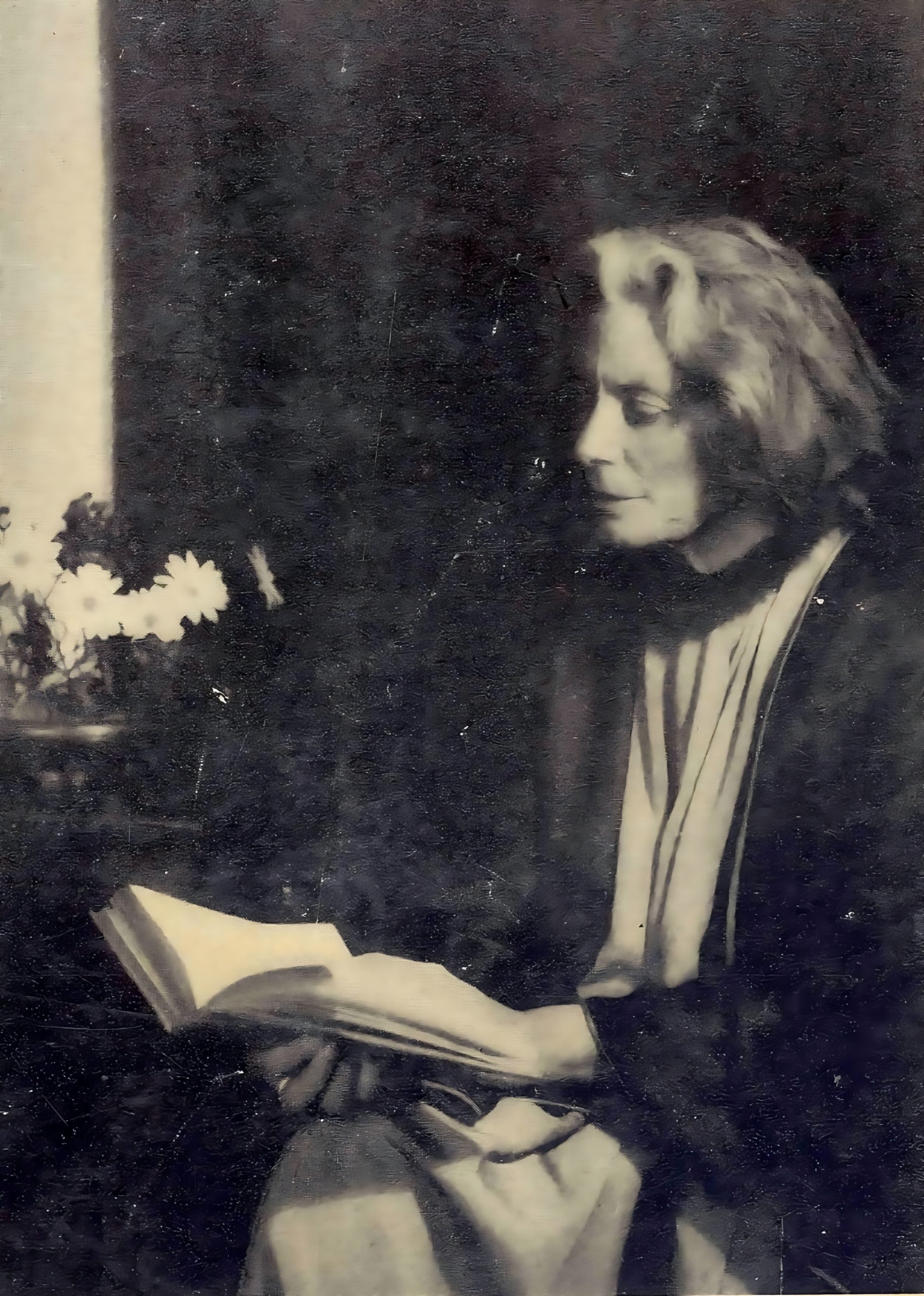
Ella Young
26 December 1867 – 23 July 1956
Ella Young – It was not until I came to Dublin and met Standish [James] O’Grady, AE and Kuno Meyer that I realized that a heritage awaited me in Celtic literature. I read every translation I could get, learned Irish and betook myself to Gaelic Ireland where, by turf fires, I could hear poems of the Fianna recited by folk who had heard the faery music and had danced in faery circles. From such folk I gathered together the tales of the Gobán Saor which later I put together in THE WONDER SMITH AND HIS SON. Ella Young writes from Oceano, California: I am still living within sound of the sea, among trees that my hands have planted. Flowering Dusk, a sort of autobiography, came into being leisurely here. I called it Things Remembered, accurately and inaccurately, but many distinguished critics, to whom I am grateful, described it in kinder and more flattering terms. William Benet said: it was one of the choicest works of literature in our time. William Rose Benét (February 2, 1886 – May 4, 1950) was an American poet, writer, and editor. In 1942, he was awarded the Pulitzer Prize for Poetry for his book of autobiographical verse, The Dust Which Is God. Benét married four times. First, on September 3, 1912, he married Teresa Frances Thompson, with whom he had three children. Teresa died in 1919. Benét’s second wife, whom he married on October 5, 1923, was poet Elinor Wylie. She died in 1928. Benét’s third wife, whom he married on March 15, 1932, was Lora Baxter. They divorced in 1937. Benét’s fourth wife, and widow, was children’s writer Marjorie Flack. They were married from June 22, 1941, until his death in 1950.
The two worlds in which Ella Young has lived – the real Ireland with its struggles for independence and its literary renaissance, and the other world of the spirit, of mystery and enchantment – are both reflected and recorded in Flowering Dusk. Her personal triumph, Kathleen Coyle wrote, is that she succeeds in giving us the essence of a life that has been lived beautifully, even when the world about her seethed with ugliness. Kathleen – novelist – was involved in the Labour Movement + the Suffragettes in Dublin. In 1937 she emigrated to America with her daughter Michele and joined the MacDowell Colony. Kathleen was born on 23 October 1886 and died in Philadelphia on 25 March 1952.
Frances Clarke Sayers (4 September 1897-24 June 1989) once described Miss Young as a woman like no other: a mystic, a scholar, a priestess of the earth, a wit and a medium through whom those who read her words are filled with longing for loveliness and with a sorrowing pity for all that goes awry through evil. Frances began her career as a children’s librarian, first working for Anne Carroll Moore at New York Public Library (1918-1923) and later as school librarian at the Corinne Seeds University Elementary School on the UCLA campus. She was inducted into the California Library Hall of Fame in 2016.
Sara Bard Field, born in 1882 to a strict orthodox Christian family, was a poet and prominent early member of the suffragist movement. I kept saying to myself again and again, until women get the vote they’re not going to be much of a power in society. She was a woman of striking political acuity and deep concern about the world’s inequities. In 1923 Sara moved with Charles Erskine Wood to a 30-acre estate named The Cats in Los Gatos, California. Following the death of his wife, CESW married Field in 1938. Charles died in 1944 and in 1955, Sara moved near her daughter in Berkeley. She died from arteriosclerotic heart disease on June 15, 1974.
All of these writers were in Ella’s life in America:
Ansel Adams
20 February 1902 – 22 April 1984
Ansel Adams, musician and photographer, was born on 20 February 1902 in San Francisco, California, the son of Charles Hitchcock Adams, a businessman, and Olive Bray – I emerged into this world at about three in the morning on 20 February 1902. The grandson of a wealthy timber baron, Adams grew up in a house set amid the sand dunes of the Golden Gate. When Adams was only four, an aftershock of the great earthquake and fire of 1906 threw him to the ground and badly broke his nose, distinctly marking him for life. A year later the family fortune collapsed in the financial panic of 1907, and Adams’s father spent the rest of his life doggedly but fruitlessly attempting to recoup. An only child, Adams was born when his mother was nearly forty. His relatively elderly parents, affluent family history, and the live-in presence of his mother’s maiden sister and aged father all combined to create an environment that was decidedly Victorian and both socially and emotionally conservative. Adams’s mother spent much of her (time brooding and fretting over her husband’s inability to restore the Adams fortune, leaving an ambivalent imprint on her son. Charles Adams, on the other hand, deeply and patiently influenced, encouraged, and supported his son. Ansel: no matter how many stars we see in a clear mountain sky, we know now that they are but a minuscule fragment of the total population of suns and planets in the billions of galaxies out there in the incomprehensible void. He died peacefully on the evening of Easter Sunday, 22 April 1984, aged 82.
Ansel’s autobiography: I described Ella thus. She was an event! Superficially eccentric she was a brilliant and sensitive woman with an imposing career in Law and Politics and had been dangerously active in the Irish Revolution. Feeling that she had fulfilled her obligation to society, she turned to poetry and Irish myths. Ella believed in the little people and said that she communicated with them often, especially her own indentured pixie, Gilpin. She was a great ceremonialist. On a trip to New Mexico in April 1929, whenever we reached a state border, she asked me to stop and would get out of the car, stand in silence for a few moments, and then pour a little wine and crumble a little bread on the new soil, chanting a few words in Gaelic. At first, this seemed odd to us but her sincerity dominated the ritual.
The final paragraph in Ansel’s autobiography is poignant: The only things in my life that are compatible with this grand universe are the creative work of the human spirit. After eighty years, I scan a long perspective. I think of a mantra of Gaelic origin given me fifty years ago (1935) by Ella Young. It echoes everything I believe: I know that I am one with beauty/ And that my comrades are one/ Let our souls be mountains/Let our hearts be worlds.
Chester Alan Arthur III
21 March 1901 – 28 April 1972
Chester Alan Arthur III (21 March 1901 – April 28, 1972) was born in Colorado. He married Charlotte Wilson in 1922. In their time in Europe Arthur and Charlotte had roles in the 1930 avant-garde film, Borderline, which also starred Paul Robeson. In the early 1930s he moved to Pismo Beach, California, and adopted the name Gavin. He founded an art and literature commune and published a short-lived magazine, Dune Forum. Within the Dunite community aged 30, he was regarded as highly educated with many personalities and somewhat eccentric. He and Charlotte divorced in 1932. In 1935, he married Esther Murphy Strachey. They were divorced in 1961. Arthur married Ellen Jansen in 1965, a long-time friend who had helped him launch Dune Forum. In 1972, Arthur died at the Fort Miley Veterans Hospital in San Francisco, aged 71. Ellen died in Pacific Grove, Monterrey County, California on 5 August 1984, aged 85.
Ella Young: Gavin is so many-sided and possesses wide views and sympathies on humanity. His life is coloured with memories of many people and places. He has known labour leaders and royal dukes, has looked from the viewpoint of both, yet kept his mind free. Always an agnostic; poet, rebel, sailor, gentleman, vagabond; born a westerner; cosmopolitan yet proudly a Californian.
Link: Dune Forum
Albert Bender
18 June 1866 – 4 March 1941
Albert Maurice Bender was born in Dublin Ireland in 1866, son of Rabbi Philip Bender and Augusta Bremer Bender, both of whom were German. In 1881, he immigrated to the United States. His maternal uncles, Joseph and William Bremer, were living in San Francisco. William hired the young Bender to work in his insurance office. Bender eventually became a very successful insurance broker in his own right. A patron of the Arts, a lover of literature from an early age, Bender began collecting rare books and created the Book Club of California in 1912. Inspired by his cousin, Anne Bremer, a professional artist, Bender began collecting local contemporary art and the arts of China, Japan and Tibet. Bender enjoyed giving things away even more than he liked acquiring them, and he became a prolific donor to Bay Area museums and libraries.
He was once called the most active buyer – and donor – of the work of California artists the state had ever known. He donated significant collections to what are now the Fine Arts Museums of San Francisco. In 1932 he donated 260 pieces of Asian art to the National Museum of Ireland in memory of his mother. He received honorary degrees from Mills College and the University of California, Berkeley. He died in 1941 aged 75. Flowering Dusk: White Ash. A Saint Patrick’s night in San Francisco. Albert Bender is holding open house, and one can see masked and fantastically-disguised figures threading the narrow court way and climbing the stairs. Albert stands in the doorway, a heavy robe of crimson silk gathered about him, his black opal ring on his finger. His guests stroll from room to room: from the library, lined with rare volumes hand-bound in vellum and Morocco, across reception-hall with its pictures and bronzes, across the dining-room with Chinese porcelains and ivories. From within comes a loud and strange burst of music. Someone has brought the Irish pipes.
Elsa Gidlow
Elsa, born in 1898, died in 1986, aged 88 was a poet, who in 1923 published the first volume of openly lesbian love poetry in the United States: On a Grey Thread. She promoted alternative spiritualities including Buddhism and Goddess Worship. At a young age she sailed with her family to Montreal, Quebec. She was first employed by a contact of her father’s in Montreal, a factory doctor as assistant editor to Factory Facts, an in-house magazine. She moved to New York in 1920 at the age of 21. There she was employed by Frank Harris of Pearson’s, a magazine supportive of poets and unsympathetic to the war and England. Later, in 1927, she moved to San Francisco, and continued to live, write and love in the San Francisco Bay Area for the rest of her life. Elsa, I Come with My Songs: the Autobiography of Elsa Gidlow gives a personal and detailed account of her life seeking, finding and creating a life with other lesbians at a time when little was recorded on the topic. In her own words:
The journalism that brought in the necessary money from magazines was done with the left hand. In a strange, detached way, the happiness of that period permeated my earning time as well. But soon there were changes, as three people entered my life who were to be interwoven with it from that time on – Ella Young, Alan Watts and Isabel Grenfell Quallo – the latter eventually ending my celibacy.
Robinson Jeffers
10 January 1887 – 20 January 1962
Robinson Jeffers was born on January 10, 1887, in Allegheny, Pennsylvania. His father, a professor of Old Testament literature and Biblical history at Western Theology Seminary in Pittsburgh, supervised Jeffers’s education, and Robinson began to learn Greek at the age of five. His early lessons were soon followed by travel in Europe, which included schooling at Zurich, Leipzig, and Geneva. When the family moved to California in 1903 Jeffers studied philosophy, Old English, French literary history, Dante, Spanish Romantic poetry, and the history of the Roman Empire graduating from the University of Southern California. Robinson was the first poet to introduce the idea of wild and untamed California spaces to a national audience. He was especially fond of the rugged coastline just north of Big Sur. Robinson’s verse celebrates the awesome beauty of coastal hills and ravines.
In 1914, Robinson (Robin) and his wife Una moved to Carmel. It was an escape: the two had met and become lovers while Una was married. Their affair was so scandalous it became news in the Los Angeles Times. Una was a tower woman. She felt a deep affinity with women in Irish ballads who learned from stone towers over tossing seas. She also had a deep appreciation for the magical. She loved unicorns, and tiny porcelain figurines, woven tapestries, and other mementos with unicorn symbolism can be found tucked into the nooks and crannies of her home. Robinson: Una excited and focused my nature, gave it eyes + nerves + sympathies. She is more like in an Irish ballad: passionate, untamed + rather heroic – or like a falcon – than an ordinary person. Ella often came to Tor House. He described her thus: she was a lovely ethereal person whose daily companions were the spirits of earth and air.
One afternoon she had gone with Una and a passing visitor to Una’s corner-room, and then to the top of the turret. They were watching a ship rounding Point Lobos when they heard two sweet chords of music several times repeated. The visitor said: Robinson Jeffers must be playing the little organ, unaware how impossible a suggestion that was. Ella, veil-enwrapped like a Druidess, said casually, I often hear faery music among the stones around this place. Una knows of no other explanation. The couple had a daughter who died a day after birth in 1913, and then twin sons, Donnan and Garth, in 1916. Una died of cancer in 1950, aged 65. Robin served on the original Board of Chancellors at the Academy of American Poets from 1946–56. He died on 20 January 1962, in Carmel, aged 75.
William Whittingham Lyman Jr.
3 January – 8 November 1983
William Whittingham Lyman Jr. born on 3 January 1885, also known as Jack Lyman, whose parents were William Whittingham Lyman and Sarah A. Nowland, was an American writer and academic, primarily in the field of Celtic studies. His father built the Lyman winery, now known as the El Molino winery. Jack studied English Literature at University of California, Berkeley. He received a university fellowship and studied Celtic languages at the University of Oxford. After a year at Oxford, he spent two years at Harvard University studying the Irish language. He returned to Berkeley to take up a post as Instructor in Celtic within the English department in 1911-1912. On 1 January 1921, he married the poet, Helen Hoyt. Helen, born on 22 January 1887, early in her career was an Associate Editor of the journal Poetry, and had numerous articles and poems published within the magazine from 1913 to 1936. She edited the September 1916 edition of Others: A Magazine of the New Verse, the woman’s number. Other magazines to publish her work include The Egoist and The Masses.
In 1922, they moved to Southern California and Jack taught English at Los Angeles City College until his retirement. The family moved back to their home near the Bale Grist Mill of St Helena. Helen died on 2 August 1972, aged 83. Jack died on 8 November 1983, aged 98, remembered as the oldest living poet. Jack: I admired Ella both as a person and as a poet.
Ella: I first met Jack early 1926 in my house in Sausalito. I stayed on his estate in St Helena on several occasions, especially once a year performing the ritual of the Fellowship of the Four Jewels over a period of ten years. He stayed overnight in Cluan Ard Oceano in the Spring of 1956 and we chatted intimately about Ireland, France, Maud Gonne, AE and the Civil War.
Kenneth Morris
31 July 1879 – 21 April 1937
Kenneth Morris was a fantasy writer and theosophist. Born in South Wales, he relocated to London with his family as a child, and was educated at Christ’s Hospital. In 1895-6, he was in Dublin, where he joined the Theosophical Society in Ely Place. There he met with Ella and her circle of friends including George William Russell AE. From 1908 to 1930, Kenneth lived in California as a staff member of the Theosophical Society headquarters at Point Loma. Ella encountered him again in California in the late 1920s. It was she who got her own publisher, Bertha Gunterman of Longmans Green, to read the manuscript of Kenneth’s Book of the Three Dragons. They published it in 1930. In Ella’s memoirs, Flowering Dusk, she discusses at length Kenneth’s writings, his love of classic Chinese poets and she quotes a number of his recensions of the poems. The last seven years of his life were spent back in his native Wales, during which time he founded seven Welsh theosophical lodges.
Lotus-by-the-sea. Kenneth came to hear me lecture at La Jolla, but with the shyness he used to have, he did not wait to speak to me. It was Carrie Coates, the irrepressible Carrie, the early friend of AE, who rushed up to say that Kenneth had stolen away, and would I not come to Point Loma where they all lived and worked and meditated: would I not come especially because Kenneth wanted so much to see me?
Georgia O’Keeffe
15 November 1887 – 6 March 1986
Georgia O’Keeffe was one of the most significant artists of the twentieth century, renowned for her contribution to modern art. Born on November 15, 1887, the second of seven children, Georgia Totto O’Keeffe grew up on a farm near Sun Prairie, Wisconsin. She graduated from high school in 1905, studied at the Art Institute of Chicago and the Art Students League in New York, where she learned the techniques of traditional painting. The direction of her artistic practice shifted dramatically four years later when she studied the revolutionary ideas of Arthur Wesley Dow. By the mid-1920s, O’Keeffe was recognized as one of America’s most important and successful artists, known for her paintings of New York skyscrapers—an essentially American symbol of modernity—as well as her equally radical depictions of flowers. In the summer of 1929, O’Keeffe made the first of many trips to northern New Mexico. The stark landscape and Native American and Hispanic cultures of the region inspired a new direction in her art. For the next two decades she spent most summers living and working in New Mexico. Georgia died in Santa Fe on 6 March 1986, at the age of 98.
John O’Shea
1876 – 29 April 1956
John O’Shea was born in Ballintaylor, Waterford, Ireland on 15 October 15, 1876. He emigrated to New York City at the age of 18 and studied at the Adelphi Academy and the Art Students League. He lived in Pasadena California from 1913 to 1917 and then settled in the Monterey area and had studios in Carmel and Pebble Beach. He was in New York from November to December 1921, exhibiting 28 watercolours and oils at the Kingore Galleries on 5th Avenue. While there he met Molly D. Shaughnessy who was likely visiting the exhibition. On May 25, 1922, O’Shea and Molly obtained a marriage license in New York City at the Municipal Building. Their wedding took take place at a later time. Molly’s parents, James Pollock and Fannie Crawford of Terre Haute, Indiana, derived their wealth from iron and steel mills. They had two daughters, Mary, known as Molly, and Emma List. Molly, born 28 November 1885, received her education at Dana Hall Girls School at Wellesley Massachusetts.
In 1906, aged twenty-one, she married Walter D. Shaughnessy, he was twenty-five years old, a real estate solicitor. He was appointed that year to the post of Consular Agent at Charleroi, Belgium, and to Consul at Aguascalientes, Mexico, a year later. Shaughnessy resigned his position with the Foreign Service on 10 April 1910 to pursue a different career but was killed in an automobile accident on 18 January 1911, near a silver mine he owned in Utah. John and Molly moved to California in 1923. Molly had inherited 10-acre site in Carmel, near Smugglers’ Cove and built a stone mansion, Tynalacan. In 1926 and 1927, O’Shea made trips to Arizona with a close friend and artist Theodor Criley. Paintings from these excursions, like the Grand Canyon, resulted in art showings in Pasadena, Tucson and San Francisco. In 1928, the O’Shea’s travelled to Tahiti in the South Pacific where he painted landscapes and seascapes. He went to New Mexico in 1930, and painted places around Taos. Molly died on October 8, 1941, at St Luke’s Hospital in San Francisco after a long illness. John died at home on 29 April 1956, aged 80.
Ella Young, The Carmelite 5 March 1930: My thoughts had been on John O’Shea’s pictures for quite a long while, ever since I heard he had been to the South Sea Islands and painted demon bananas and magical rose and purple fishes.
Portrait of Ella Young: with equal skill John presents the personalities of his portraits. Ella Young’s blue eyes in the watercolour portrait of her speak vividly of the mystic beauty of the world she lives in. In January 1944 Ella wrote to his sister-in-law, Emma Pine: John is brown and strong-looking, says he climbs hillsides and is much in the open air.
Ella Young, Flowering Dusk: He has caught on his canvas the weight of a bough, the impatient frustrated surge of the sea, the very muscle and texture of rocks. Point Lobos trees: I am sure that John O’Shea, in painting, notes those trees: he has a passionate sympathy with the will of a tree to thrust skyward, the will of a cliff to endure. EQUINE FRIEND: In this idea he is heartened by Molly and by myself, chiefly, I think, because we admire John’s work so much and are really curious to see what goats would look like on John’s canvas. CYPRESS AND SEA: There is a sound of bees in the valley as we descend. There is a fragrance of orchard trees and stream-delighting willows. Speaking of the view of the sea from Cliff Property: The sea curls in waves behind him, sapphire-blue except where churning foam transfigures it to chalcedony. At night in that house by the sea that John O’Shea’s pictures and Molly’s rose damasks and blue enamels made so colourful.
Harry Partch
24 June 1901 – 3 September 1974
Harry Partch born June 24, 1901 was one of the first twentieth-century composers to work extensively and systematically with micro tonal scales. Harry was a visionary composer and leading figure in the development of an indigenously American contemporary music. Amazingly Harry was attracted to Ella’s poetry. In March 1941 he attended a poetry reading by Ella Young, who gave him a copy of her book Marzilian. He was drawn to spunky gals (his mom was one), and especially the non-Christian types. He wrote the music for three of Ella’s poems (Intrusions) in 1952: The Wind, (with lines from Lao-tzu appended), The Rose (heavenly symbol: ancient symbol of Ireland) and The Waterfall. His final completed work was the soundtrack to American philanthropist and photographer Betty Freeman’s The Dreamer that Remains. He retired to San Diego in 1973, where he died after suffering a heart attack on 3 September 1974, aged 73.
John + Agnes Varian
John Varian: 1863 – 09 January 1931
John + Agnes Varian born and raised in Ireland, were members of the Theosophical Society in Dublin. They emigrated from Ireland to the United States in 1894, first settling in Syracuse, New York where they joined the Temple of the People. In 1903 they relocated to Halcyon California. John was the leader of The Temple and Agnes was the first Halcyon Storekeeper and Postmistress. Ansel Adams knew the Varian family for over thirty years and when John died on 9 January 1931, he wrote a poem To John Varian published later that year. Agnes Dickson Varian, born 2 March 1861 Ireland, death 23 September 1935 aged 74. John and Agnes had three sons, Russell, Sigurd and Eric. The family was not wealthy, but noted in the community for being loving, humorous and adventurous. Russell (1898 – 1959) and Sigurd (1901 – 1961), invented the klystron, an important microwave amplifier tube, and founded the Varian electronics empire. Eric Varian, remained in the Halcyon area. He had a career in the central California coast as an electrical contractor, and, beginning in the early 1960s, also assisted the work of his daughter, Sheila Varian, in building a horse ranch, and she became a notable breeder of Arabian horses.
Flowering Dusk: HALCYON. The countryside has a subtle beauty of its own, stretching in sandy undulations to the sea with a peaked and isolated hill here and there and ranges of mountains in every direction. I have a small cottage near the Halcyon Temple. It is the guest-cottage belonging to John and Agnes Varian, and stands near their two-storied building. I have persuaded them to rent it to me and I am working hard at my book: The Tangle-Coated Horse. John Varian is working at an epic poem which deals with the birth of worlds and cosmogonies: it has Celtic gods with well-known names and gods that he has invented. John knows some folk that I know in Ireland. He is a cousin of Dora Sigerson, the poet. This is a place where one can write. I have a grove of apricot trrees close to my cottage, and all about me is John Varian’s garden where things grow as they please. He works intermittently at his epic. One line of it delights me: The word Lir uttered in the cold/Flowered into suns, and seeded into sleep.
Alan Watts
06 January 1915 – 16 November 1973
Alan Watts, born in Kent England, died in San Francisco, aged 58, popularised the counterculture movement of the 1960s in the United States. In 1938 Watts immigrated to America, studied Zen Buddhism in New York City, then in 1941 entered Evanston University, Chicago, graduating with a Master’s Degree in Theology in 1945. He moved to San Francisco in 1950 and joined the American Academy of Asian Studies, where he served as administrator, studying Japanese art and culture. In the last years of his life, Watts fell into a deep depression and episodes of heavy drinking. In 1973 he died in his sleep at Druid Heights, a bohemian community in Muir Woods, San Francisco Bay.
In his autobiography, In My Own Way, Watts reminisced on meeting Ella one evening (early 1953) in Elsa Gidlow’s Fairfax home: this frail, transparent, bewitching old lady talked to us like a true shaman about the personalities of mountains, and about talking to the weather and to wild animals, and we talked about a film we had both seen in 1926 of attempts to climb Everest, embellished with scenes of Tibetan dancing.
Charles Eskine Scott Wood
20 February 1852 – 22 Janruary 1944
Charles Erskine Scott Wood died a month before his ninety-second birthday at his home The Cats in 1944. William Rose Benet called him a man of the highest idealism… whose lifetime was devoted to courageous battling for the rights of the underprivileged… a poet superior in keenness of intellect to Walt Whitman. At the end of December 1930 Ella had not received legal immigration status. CESW advised her to go to Victoria, British Columbia, in order to restart the process toward American citizenship. Her application for re-entry to the U.S. was declined for months on the grounds that she might become a public charge. In Ella’s memoirs, as she doses in front of her fire in Cluan Ard a crash of a log falls to ashes stirs her and she recalls a morning at The Cats and breakfast on the patio with grapevines twinning in lattice-work, and a cherry tree spring into the blueness. Sara Bard Field and Erskine Scott Wood on their vineyard-crowned hillside. The talk is of poetry; and two police dogs, one black, one golden, stand by to listen.